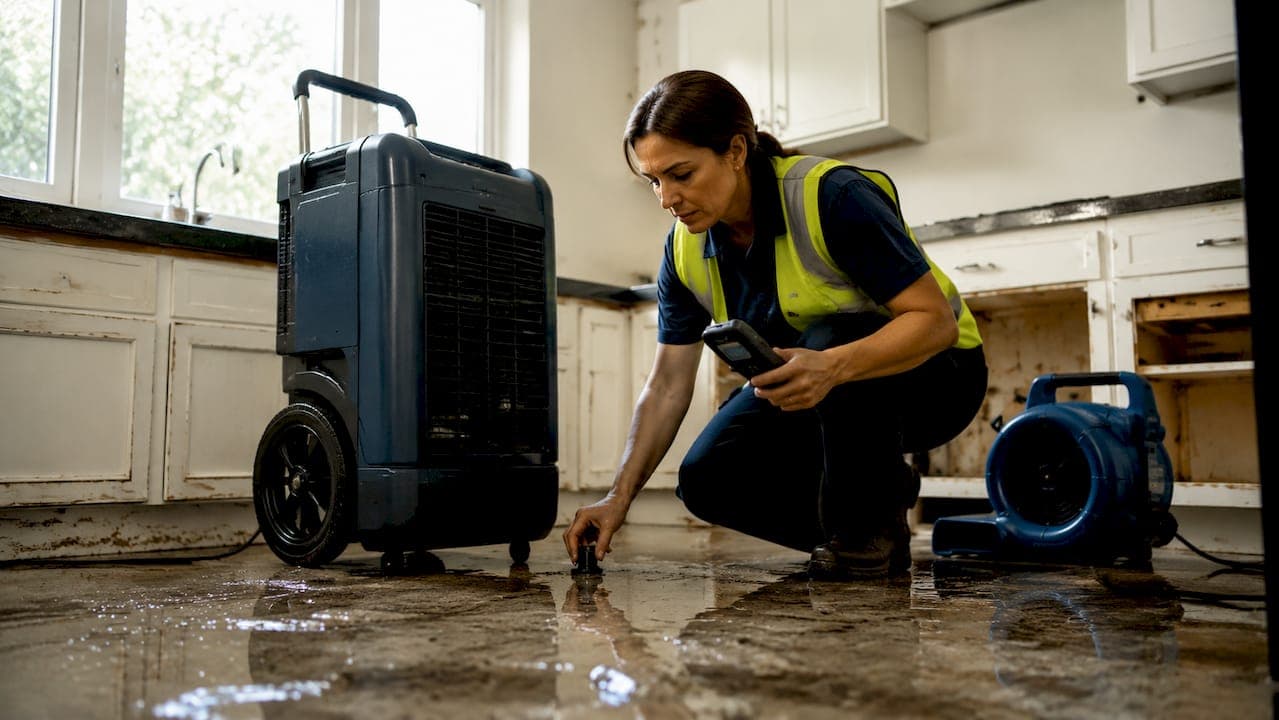
Dehumidification is defined as the controlled removal of moisture vapor from the air, and it is the core process that determines whether a water-damaged property dries safely or develops mold. The EPA recommends keeping indoor humidity between 30% and 50% during restoration. The industry standard ANSI/IICRC S500 sets a critical 24–48 hour window for drying wet materials before mold colonization begins and material replacement becomes necessary. Understanding how dehumidifiers aid restoration gives you a clear picture of what professional drying actually involves, and why the right equipment matters from the first hour.
How do dehumidifiers work during the restoration process?
Water extraction and dehumidification are two separate, sequential stages. Extraction removes bulk standing water using pumps and wet vacuums. Dehumidification removes the moisture vapor that wet walls, floors, and structural materials release after extraction. Skipping either stage leaves the job unfinished.
Professional restoration uses air movers and dehumidifiers as a paired system. Air movers blow high-velocity air across wet surfaces, accelerating evaporation and pulling moisture into the air. Dehumidifiers then capture that airborne moisture and exhaust warm, dry air back into the space. That warm exhaust raises the room temperature slightly, which increases the vapor pressure differential between wet materials and the surrounding air. A higher differential means faster drying.
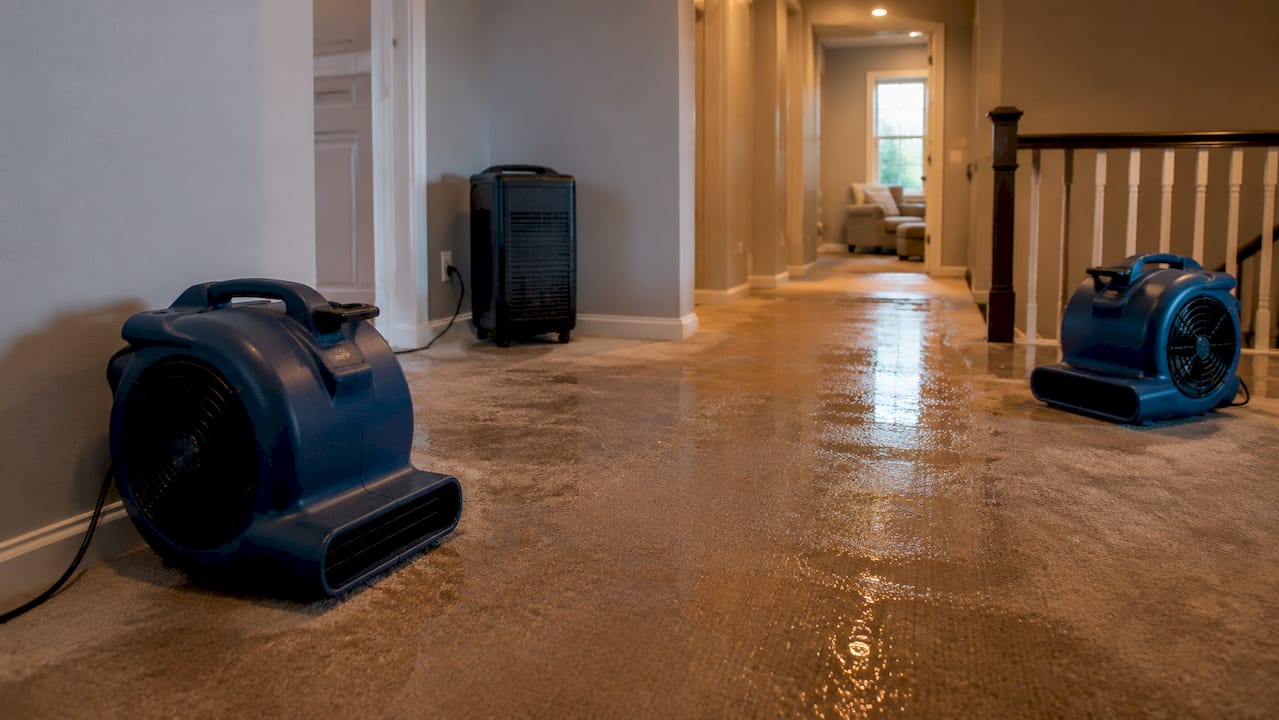
Without dehumidification, moisture vapor stays suspended in the air and eventually re-condenses on cooler surfaces. That re-condensation stalls drying and causes secondary damage to areas that were never directly wet. Dehumidifiers prevent this cycle by continuously removing captured moisture and exhausting it as condensate or warm vapor.
Here is what the system accomplishes at each stage:
- Extraction: Pumps and wet vacuums remove standing water from floors, cavities, and subfloor assemblies.
- Air movement: Air movers drive evaporation from wet surfaces, loading moisture into the air.
- Dehumidification: Dehumidifiers capture airborne moisture, maintaining a low-humidity environment that keeps evaporation moving.
- Monitoring: Moisture meters and thermo-hygrometers track material moisture content and relative humidity to confirm drying progress.
Pro Tip: Run air movers and dehumidifiers simultaneously from the start. Turning on air movers without dehumidifiers raises indoor humidity fast, which can spread moisture to unaffected areas.
What types of dehumidifiers are used for water damage restoration?
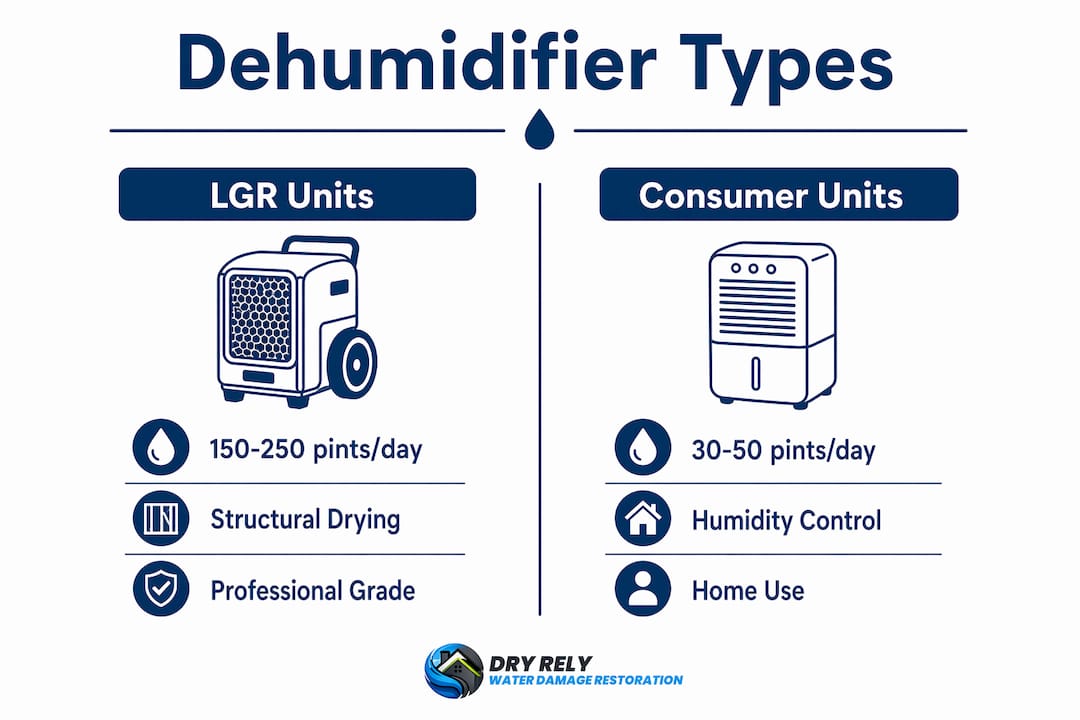
The equipment type determines whether drying finishes in days or drags on for weeks. Two categories matter here: professional Low Grain Refrigerant (LGR) dehumidifiers and consumer-grade units.
LGR dehumidifiers
LGR dehumidifiers are the industry standard for structural drying. They remove 150–250 pints per day, which is four to six times the capacity of a typical consumer unit. That capacity gap is not a minor difference. It means a professional unit can handle the moisture load from wet drywall, subfloor, and framing simultaneously. LGR units also maintain extraction effectiveness down to 20% relative humidity, which matters when drying dense materials like hardwood or concrete block. Consumer units lose efficiency below 50% RH, so they stop performing precisely when the job demands the most.
Consumer-grade dehumidifiers
Consumer units remove 30–50 pints per day. They work well for ongoing humidity control in basements or crawl spaces under normal conditions. After a flood or pipe burst, they are not built for the moisture load. Running a consumer unit alone on a water-damaged property extends drying time significantly and raises mold risk.
| Feature | LGR dehumidifier | Consumer dehumidifier |
|---|---|---|
| Extraction capacity | 150–250 pints/day | 30–50 pints/day |
| Effective RH range | Down to 20% RH | Loses efficiency below 50% RH |
| Best use | Structural drying jobs | Routine humidity maintenance |
| Typical user | Restoration professionals | Homeowners, general use |
Pro Tip: If a contractor shows up with only consumer-grade dehumidifiers for a flooded room, ask specifically what extraction capacity the units carry. The number tells you whether the equipment matches the job.
How should dehumidifiers be placed and used effectively?
Placement determines whether the drying system works as designed or creates dead zones where moisture hides. The industry standard ratio is one LGR dehumidifier for every three to four air movers, adjusted based on drying class and cubic footage. Drying classes range from Class 1 (minimal absorption) to Class 4 (specialty drying for dense materials), and each class changes the equipment count.
Follow these placement principles on any restoration job:
- Position dehumidifiers centrally in the drying zone so exhaust air circulates evenly across all wet surfaces.
- Avoid placing dehumidifiers in corners or against walls, which restricts airflow and reduces capture efficiency.
- Keep doors and windows closed in the drying zone to maintain a controlled environment and preserve vapor pressure differential.
- Check moisture readings daily using a calibrated moisture meter on structural materials and a thermo-hygrometer for ambient conditions.
- Adjust equipment count if readings plateau for more than 24 hours. A stalled reading usually signals inadequate dehumidification capacity or a hidden moisture source.
Dehumidifiers stabilize drying zone temperature by exhausting warm dry air, which sustains the evaporation rate that air movers drive. Disrupting that balance by opening windows or turning off units overnight extends total drying time and raises costs.
| Drying class | Moisture level | Typical equipment ratio |
|---|---|---|
| Class 1 | Low absorption (carpet, small area) | 1 LGR per 4 air movers |
| Class 2 | Significant absorption (walls, floors) | 1 LGR per 3–4 air movers |
| Class 3 | Greatest absorption (ceilings, walls) | 1 LGR per 3 air movers |
| Class 4 | Specialty drying (hardwood, concrete) | Calculated per material density |
You can learn more about how technicians assess damage and set up monitoring in a restoration damage assessment to understand what proper documentation looks like.
What are the benefits and limitations of dehumidifiers in home restoration?
Dehumidifiers deliver three concrete benefits in any restoration project. First, they accelerate drying by maintaining the low-humidity environment that keeps moisture moving out of wet materials. Second, they prevent mold. Mold growth begins within 24–48 hours on wet surfaces, and sustained dehumidification cuts off the moisture supply mold needs. Third, they protect building materials. Wood framing, drywall, and adhesives all absorb and release moisture. Controlled drying prevents warping, swelling, and delamination.
The limitations are equally real, and ignoring them causes problems.
- Dehumidifiers do not replace extraction. Running a dehumidifier in a room with standing water accomplishes almost nothing. Extraction must come first.
- Consumer units cannot handle structural drying. Their capacity is too low and their effective humidity range too narrow for post-flood conditions.
- Overly aggressive drying causes damage. Hardwood floor warranties often require maintaining 30%–50% RH during drying. Dropping below that threshold can cause cracking, shrinkage, and voided warranties on adhesives and flooring.
- Neglecting airflow creates pockets of trapped moisture. Incorrect equipment ratios or omitting air movers leads to prolonged drying, higher costs, and mold risk in areas that looked dry on the surface.
Pro Tip: Document relative humidity and grain per pound (GPP) readings daily. These readings protect your insurance claim and satisfy manufacturer warranty requirements if flooring or adhesive damage is disputed later.
Tracking humidity levels also connects directly to mold prevention after flooding, where EPA-recommended thresholds guide safe drying timelines.
Key Takeaways
Dehumidifiers are not a standalone fix. They work as part of a paired system with air movers, and the equipment must match the drying class, space size, and material type to prevent mold and structural damage.
| Point | Details |
|---|---|
| Drying window is 24–48 hours | Wet materials must reach safe moisture levels within 48 hours to prevent mold and avoid replacement. |
| LGR units outperform consumer models | Professional LGR dehumidifiers remove 150–250 pints per day, four to six times more than consumer units. |
| Placement and ratios matter | Use one LGR dehumidifier per three to four air movers, adjusted for drying class and cubic footage. |
| Overly fast drying causes damage | Dropping below 30% RH during drying can crack hardwood and void flooring and adhesive warranties. |
| Documentation protects you | Daily RH and GPP readings support insurance claims and satisfy manufacturer warranty requirements. |
What I've learned about dehumidification that most guides skip
After restoring over 15,000 properties across South Florida, the Dry Rely Water Damage Restoration team has seen one pattern repeat more than any other: homeowners focus on the water they can see and ignore the moisture they cannot. A floor that feels dry to the touch can hold 20% more moisture than the safe threshold inside the subfloor assembly. That hidden moisture is where mold starts.
The ANSI/IICRC S500 standard exists for exactly this reason. It is not a suggestion. It defines equipment calculation methods, drying class criteria, and documentation requirements because the consequences of getting it wrong are structural. A property that looks restored but still holds excess moisture will develop mold within weeks, and by then the damage is far more expensive to fix.
The other lesson is about documentation. Moisture and atmospheric readings are not just technical records. They are your protection when an insurance adjuster questions the scope of work or a flooring manufacturer disputes a warranty claim. Every professional drying job should produce a daily log of RH, GPP, and material moisture content readings. If your restoration contractor cannot provide that log, that is a problem worth addressing before the job closes.
Dehumidification works. But it works only when the equipment is right, the placement is deliberate, and someone is tracking the numbers every day.
— Dry Rely Water Damage Restoration
Dry Rely Water Damage Restoration: professional drying for South Florida properties
Dry Rely Water Damage Restoration deploys certified technicians on-site within 60 minutes of your call, equipped with professional LGR dehumidifiers, air movers, thermal imaging cameras, and calibrated moisture meters. Every job follows ANSI/IICRC S500 protocols from initial extraction through final drying verification.

Whether you are dealing with a burst pipe, storm flooding, or a slow leak that has soaked into your walls, the Dry Rely team handles the full process: water extraction and removal, structural drying, humidity monitoring, and mold prevention. With over 15,000 properties restored and a 4.9-star rating from more than 200 reviews, Dry Rely delivers results you can verify. Contact Dry Rely Water Damage Restoration for a professional assessment and a complete restoration plan built around your property's specific drying needs.
FAQ
How do dehumidifiers help after water damage?
Dehumidifiers remove moisture vapor from the air after water extraction, maintaining low indoor humidity that keeps wet materials drying and prevents mold growth within the critical 24–48 hour window.
Can I use a store-bought dehumidifier for flood restoration?
Consumer dehumidifiers remove only 30–50 pints per day and lose efficiency below 50% RH, making them inadequate for structural drying jobs that require professional LGR units operating at 150–250 pints per day.
How long should dehumidifiers run after water damage?
Dehumidifiers should run continuously until moisture meter readings confirm that structural materials have returned to normal moisture content, which typically takes several days depending on the drying class and material type.
What humidity level is safe during restoration?
The EPA recommends maintaining indoor humidity between 30% and 50% during drying. Dropping below 30% RH risks cracking hardwood and voiding flooring warranties, while staying above 50% RH allows mold to develop.
Do I need both air movers and dehumidifiers?
Yes. Air movers drive evaporation from wet surfaces, and dehumidifiers capture the resulting airborne moisture. Running one without the other extends drying time, raises costs, and increases mold risk.