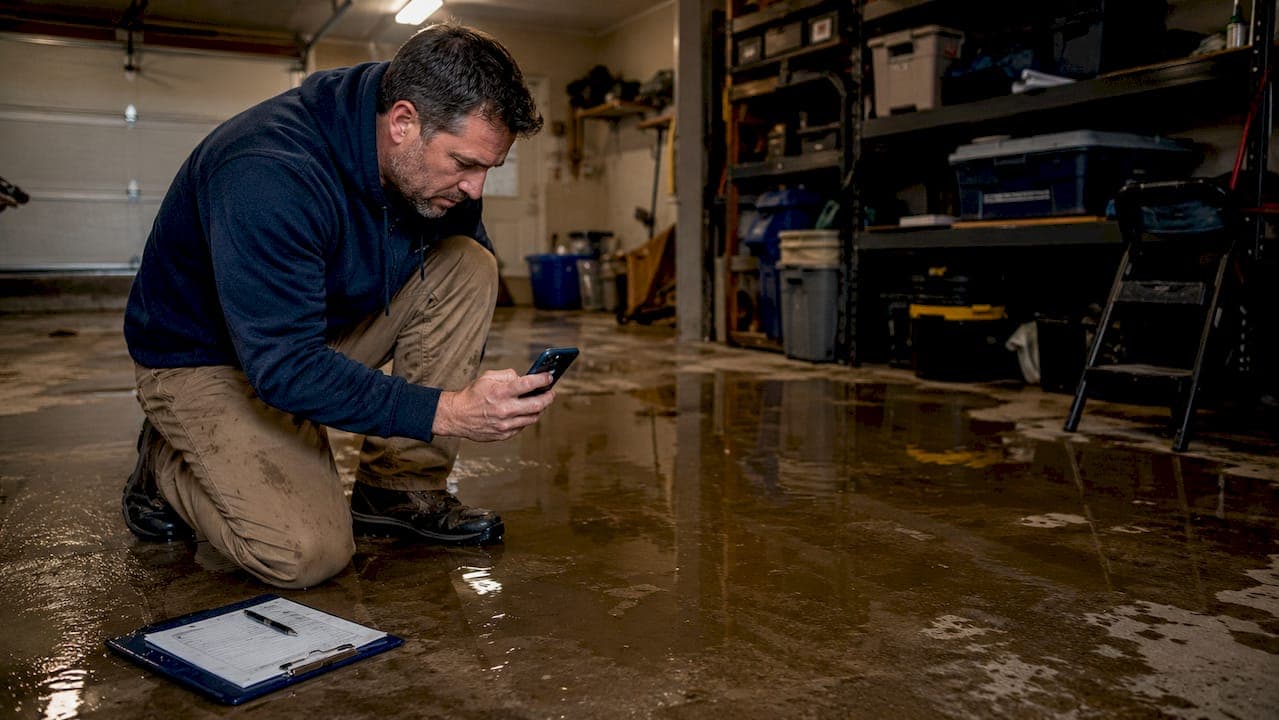
Water damage documentation for insurance claims is the process of capturing precise, timely, and thorough evidence of sudden water damage to support your insurance payout. Done right, it is the single biggest factor separating approved claims from denied ones. Insurers require proof that damage was sudden and accidental, not the result of neglect or gradual seepage. These water damage documentation tips for claims cover every step, from the first photo you take to the supplemental report you submit when a settlement comes in low.
1. What evidence do you need to collect immediately after water damage?
Photos and videos taken before mitigation are the foundation of every successful claim. Adjusters need to see the damage in its original state, before you move furniture, pull up flooring, or run fans. Capture wide shots of each affected room, then move in for close-ups of stains, buckled flooring, and saturated walls.
Your evidence checklist should include:
- Wide-angle room shots showing the full scope of damage
- Close-up photos of waterlines, staining, and structural damage
- Photos of the water source such as the burst pipe, failed appliance hose, or leaking roof joint
- A video walkthrough narrating what you see in each room
- A written timeline noting the exact date, time, and how you discovered the damage
Pro Tip: Use your smartphone's built-in camera app, which automatically embeds timestamps and GPS coordinates into each photo. That metadata becomes part of your claim record.
Preserving damaged items matters just as much as photographing them. Discarding items early can lead to payout reduction or outright denial. Stack damaged belongings in a dry area and wait for the adjuster's inspection before disposing of anything.
2. How to document the water source to prove your claim
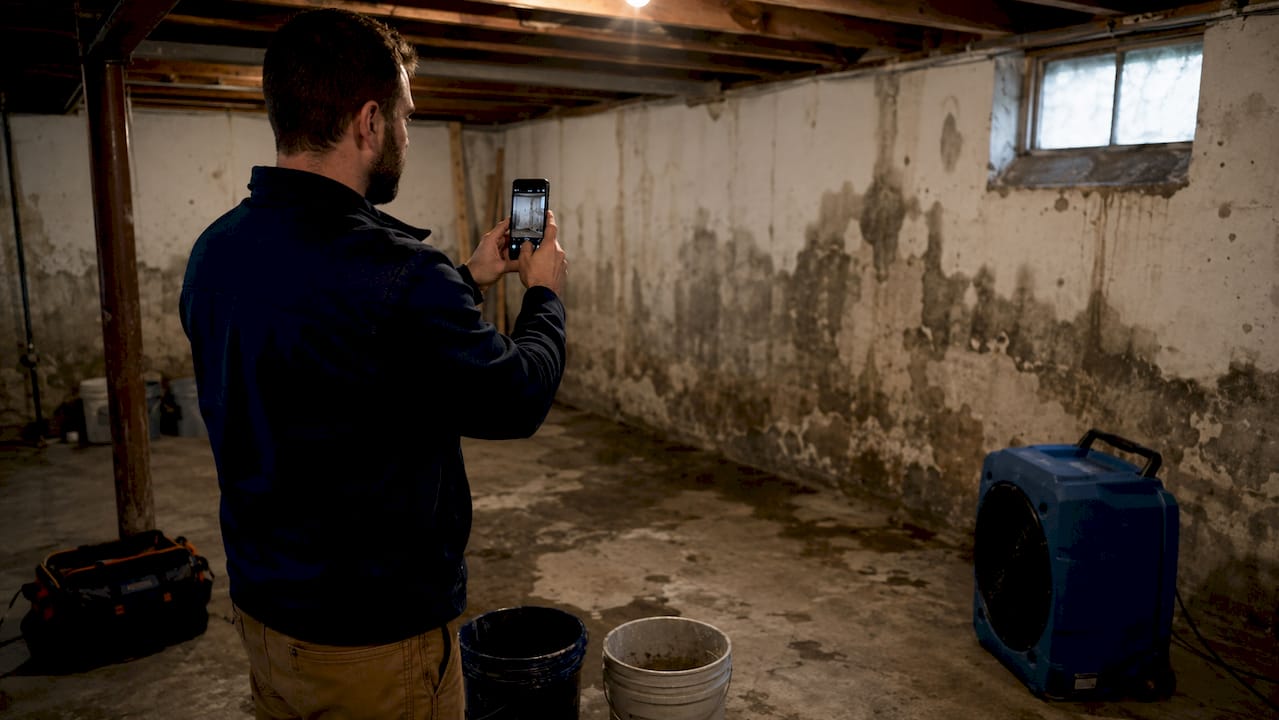
Insurance adjusters deny most claims that lack clear proof the damage was sudden. Photographing the exact damaged pipe or valve is the single most effective way to prove cause and avoid denial. A photo of a wet ceiling means little without a corresponding photo of the cracked supply line above it.
Get as close as safely possible to the source. If a washing machine hose failed, photograph the hose, the connection point, and the water pooled beneath the unit. If a pipe burst inside a wall, photograph the opening in the wall and the broken pipe before any repairs begin. That sequence tells the adjuster a clear story: sudden failure, not years of slow leaking.
3. How to organize your documentation records for a smooth claim
A claim with organized records moves faster and pays more. Create a dedicated folder on your phone or computer the day damage occurs. Label subfolders by category: photos, videos, receipts, and correspondence.
Build a written inventory of every damaged item. List the item name, estimated age, original purchase price, and replacement cost. Receipts for emergency mitigation such as fan rentals, wet vacuums, and temporary lodging are reimbursable under many policies. Save every receipt, even for small purchases.
Pro Tip: A free spreadsheet tool like Google Sheets works well for tracking damaged items. Add columns for item name, purchase year, estimated value, and replacement cost. Share the sheet directly with your adjuster to cut back-and-forth time.
Keeping a communication log with your insurer, including dates, names, and call summaries, protects you from disputes about what was reported and when. Log every phone call and save every email in your claim folder.
4. Why before-loss records strengthen your position
Pre-damage documentation is the most overlooked tool in a homeowner's claim arsenal. If you have photos or home inspection reports showing your property was in good condition before the loss, those records directly counter any insurer argument about neglect. The absence of prior moisture or mold in the affected area must be clearly documented to avoid suspicion of neglect.
Take annual photos of your mechanical systems: water heater, supply lines, appliance connections, and roof condition. Store them in a cloud folder labeled by year. If damage occurs, you can pull up last year's photos and show the pipe was intact and dry. That single step has saved homeowners from claim denials that would otherwise be very difficult to fight.
5. How to format documentation the way insurers expect
Restoration estimates in Xactimate format are the industry standard for insurance adjusters. Xactimate is software used by adjusters and restoration contractors to price repairs using standardized line items for labor, materials, and equipment. When your contractor submits a non-Xactimate quote, the adjuster must manually re-enter every line item. That delay costs you time and increases the chance of errors.
A strong restoration report includes:
- Line-item cost breakdowns for labor, materials, and equipment separately
- Moisture meter readings showing moisture levels at affected surfaces
- Thermal imaging reports identifying hidden moisture behind walls or under floors
- Drying logs tracking daily moisture reduction during the mitigation phase
- Photos embedded directly in the report, matched to specific line items
Thermal imaging and moisture meter data are accepted as strong evidence by insurers. They document damage that is invisible to the naked eye, which protects you from underpayment on hidden structural repairs.
Pro Tip: Ask your restoration contractor directly whether they use Xactimate for estimates. If they do not, find one who does. The difference in claim processing speed is significant.
6. What documentation mistakes lead to denied or reduced claims?
Most claim denials trace back to a small set of avoidable errors. Knowing them in advance puts you in control.
- Skipping the source photo. A photo of wet drywall without a photo of the burst pipe gives the adjuster room to argue gradual damage.
- Filing late. Early notification to your insurer, ideally within 24–72 hours, is critical. Delays can result in denial or reduced payment.
- Throwing away damaged property. Keep everything until the adjuster has inspected it in person.
- Ignoring your deductible. Standard homeowners deductibles typically range from $500 to $2,500 per claim. If repair costs fall near that range, filing may not be worth the premium increase.
- Confusing gradual damage with sudden damage. A slow roof leak that went unaddressed for months is not covered the same way a sudden pipe burst is. Document the timeline carefully to show the damage was new.
- Failing to document your mitigation steps. Insurers expect you to prevent further damage. Photograph every step you take, from placing buckets to calling a restoration company.
Understanding what water damage insurance covers before you file helps you frame your documentation around covered perils from the start.
7. How to file a water damage insurance claim step by step
Filing a claim is a process, not a single phone call. Follow these steps in order to protect your payout.
- Stop the water source if it is safe to do so.
- Document everything before touching or moving anything.
- Call your insurer within 24 hours and report the loss.
- Request a claim number and the name of your assigned adjuster.
- Schedule a professional restoration assessment to produce a written damage report.
- Submit your photo and video evidence along with your written damage timeline.
- Follow up in writing after every phone call to create a paper trail.
What to do in the first 24 hours after water damage is a critical window. The actions you take in that period shape the entire claim outcome.
8. How to supplement an underpaid water damage claim
An underpaid claim is not a closed claim. You have the right to dispute a low settlement with additional documentation.
Start by requesting an itemized explanation from your insurer. Ask specifically which line items were reduced and why. Then gather:
- Updated repair estimates from a licensed contractor, preferably in Xactimate format
- Additional photos of damage the adjuster may have missed
- A revised property inventory with updated replacement values
- Expert reports such as a structural engineer's assessment or a mold inspection
Pro Tip: A public adjuster works on your behalf, not the insurer's. They typically charge a percentage of the final settlement but often recover significantly more than the original offer. For large or complex claims, that tradeoff is worth calculating.
Restoration companies familiar with insurance standards produce documentation that meets adjusters' expectations, which reduces processing times and denials. Partnering with the right restoration company from day one is the most reliable way to avoid the supplemental claim process entirely.
Key Takeaways
Thorough, timely, and insurer-formatted documentation is the most reliable way to secure a full water damage insurance payout and avoid denial.
| Point | Details |
|---|---|
| Document before cleanup | Photograph and video all damage before moving anything or starting mitigation. |
| Photograph the water source | A photo of the failed pipe or appliance proves sudden damage and prevents denial. |
| Use Xactimate-format estimates | Restoration reports in Xactimate format process faster and reduce adjuster disputes. |
| File within 24–72 hours | Late notification is a leading cause of claim denial or reduced settlement. |
| Keep all receipts and logs | Emergency mitigation receipts and communication logs are reimbursable and legally protective. |
What we have learned from 15,000 restored properties
The most common reason homeowners lose money on water damage claims is not fraud or bad faith from insurers. It is incomplete documentation. After restoring over 15,000 properties across South Florida, the pattern is consistent: homeowners who photograph the source, preserve damaged items, and submit organized records get paid faster and more fully.
What surprises most people is how much weight adjusters give to the water source photo specifically. A cracked supply line behind a toilet, a failed washing machine hose, a split pipe in the ceiling. That single image tells the adjuster the damage was sudden and accidental. Without it, the claim enters a gray zone where gradual damage arguments are easy to make and hard to disprove.
The other oversight I see constantly is homeowners discarding damaged flooring or drywall before the adjuster arrives. They want to start cleaning up, which is completely understandable. But that material is your evidence. Once it is gone, the adjuster has only your word and your photos. Keep it until you have written confirmation that the inspection is complete.
My strongest recommendation is to prepare before damage ever occurs. Take annual photos of your mechanical systems, keep your maintenance records, and know your policy deductible. Homeowners who do that walk into a claim with confidence. Those who do not spend weeks fighting for what they are owed.
— Dry Rely Water Damage Restoration
Professional documentation support when it matters most
Water damage moves fast. So does the window for capturing the evidence that protects your claim.
Dry Rely Water Damage Restoration arrives on-site within 60 minutes of your call across South Florida. The team documents damage using thermal imaging and moisture meters before a single drop of water is extracted, producing insurer-ready reports in Xactimate format. That documentation goes directly to your adjuster, reducing delays and disputes. With a 4.9-star rating across more than 200 reviews, Dry Rely's water damage restoration services are built around getting you paid and getting your property back to normal. Call now and let a certified technician handle both the damage and the paperwork.
FAQ
What is a water damage insurance claim?
A water damage insurance claim is a formal request to your homeowners insurer for reimbursement of repair costs caused by sudden and accidental water damage. Coverage typically includes burst pipes, appliance failures, and storm-driven water intrusion, but excludes gradual leaks and flooding from outside the home.
How do I prove a water damage insurance claim?
Photograph the water source, document all damage before cleanup, preserve damaged items for adjuster inspection, and submit a written timeline with your photos and a professional restoration estimate. Restoration estimates in Xactimate format process faster and carry more weight with adjusters.
What does water damage insurance typically cover?
Standard homeowners insurance covers sudden and accidental water damage from burst pipes, overflowing appliances, and roof leaks caused by a covered storm event. It does not cover gradual seepage, flooding from outside, or damage caused by lack of maintenance.
How do I supplement an underpaid water damage claim?
Request an itemized denial or reduction explanation from your insurer, then submit additional repair estimates, updated photos, and a revised property inventory. A public adjuster can negotiate on your behalf for complex or high-value claims.
How soon should I file a water damage claim?
File within 24–72 hours of discovering the damage. Delays beyond that window can result in claim denial or a reduced settlement, as insurers may argue the damage worsened due to inaction.